
Markus Reinert, M.Sc.
Guest Scientist

Hi, I'm Markus Reinert, Ph.D. student in Physical Oceanography in the Estuarine and Coastal Ocean Processes group at IOW. I'm interested in the role of the ocean in the Earth's climate system. Read more about my research during my time at IOW below.
E-mail address: markus.reinert@iow.de
My work on GitHub: markusReinert
Let's connect on LinkedIn or ResearchGate.
My PhD project

The Arctic is one of the areas most affected by climate change and the focus of my PhD research. I want to understand how Greenland's glaciers are melted by the ocean water below their ice tongues. My main tool for this are high-resolution numerical simulations with GETM, the General Estuarine Transport Model. My research is part of the project GROCE (Greenland ice sheet–ocean interaction) and associated to the project TRR 181: Energy Transfers in Atmosphere and Ocean.
We summarized the main findings of the GROCE project in a recently published synthesis paper:
Torsten Kanzow et al. (2025). The system of atmosphere, land, ice and ocean in the region near the 79N Glacier in northeast Greenland: synthesis and key findings from the Greenland Ice Sheet–Ocean Interaction (GROCE) experiment. The Cryosphere. DOI: 10.5194/tc-19-1789-2025 (open access)
My main contribution in this paper is the idealized high-resolution 3D model of a glacier fjord in Greenland, which we compare with other models and observations in Sections 3.13 and 4.11.
This 3D model is an extension of our idealized 2D model of the 79° North Glacier fjord, which we used to study the dynamics of the ocean currents melting the glacier. Furthermore, we demonstrated with this model how an adaptive model grid enables high resolution in the places where it is needed. Our results have been published in:
Markus Reinert, Marvin Lorenz, Knut Klingbeil, Bjarne Büchmann, Hans Burchard (2023). High-resolution simulations of the plume dynamics in an idealized 79°N Glacier cavity using adaptive vertical coordinates. JAMES. DOI: 10.1029/2023MS003721 (open access)
Animation of my idealized 2D model of the 79°N Glacier fjord
This study builds on our earlier work, where we used a 1D ocean turbulence model (GOTM) to study the vertical structure and entrainment of meltwater plumes under floating ice tongues and ice shelves:
Hans Burchard, Karsten Bolding, Adrian Jenkins, Martin Losch, Markus Reinert, Lars Umlauf (2022). The Vertical Structure and Entrainment of Subglacial Melt Water Plumes. JAMES. DOI: 10.1029/2021MS002925 (open access)
List of my papers at IOW
2025
- Kanzow, T., A. Humbert, T. Mölg, M. Scheinert, M. Braun, H. Burchard, F. Doglioni, P. Hochreuther, M. Horwath, O. Huhn, M. Kappelsberger, J. Kusche, E. Loebel, K. Lutz, B. Marzeion, R. McPherson, M. Mohammadi-Aragh, M. Möller, C. Pickler, M. Reinert, M. Rhein, M. Rückamp, J. Schaffer, M. Shafeeque, S. Stolzenberger, R. Timmermann, J. Turton, C. Wekerle and O. Zeising (2025). The system of atmosphere, land, ice and ocean in the region near the 79N Glacier in northeast Greenland: synthesis and key findings from the Greenland Ice Sheet–Ocean Interaction (GROCE) experiment. The Cryosphere 19: 1789-1824, doi: 10.5194/tc-19-1789-2025
- Mohammadi-Aragh, M., O. Zeising, M. Reinert, K. Klingbeil, A. Humbert, R. McPherson, M. Morlighem, R. Timmermann, C. Wekerle and H. Burchard (2025). Impact of Ice Topography, Basal Channels and Subglacial Discharge on Basal Melting Under the Floating Ice Tongue of 79N Glacier, Northeast Greenland. J. Adv. Model. Earth Syst. 17: e2024MS004735, doi: 10.1029/2024MS004735
2023
- Reinert, M., M. Lorenz, K. Klingbeil, B. Büchmann and H. Burchard (2023). High-resolution simulations of the plume dynamics in an idealized 79°N Glacier Cavity using adaptive vertical coordinates. J. Adv. Model. Earth Syst. 15: e2023MS003721, doi: 10.1029/2023MS003721
2022
- Burchard, H., K. Bolding, A. Jenkins, M. Losch, M. Reinert and L. Umlauf (2022). The vertical structure and entrainment of subglacial melt water plumes. J. Adv. Model. Earth Syst. 14: e2021MS002925, doi: 10.1029/2021MS002925
- Roustan, J.-B., L. Pineau-Guillou, B. Chapron, N. Raillard and M. Reinert (2022). Shift of the storm surge season in Europe due to climate variability. Sci. Rep. 12: 8210, doi: 10.1038/s41598-022-12356-5
2021
- L’Her, A., M. Reinert, S. Prants, X. Carton and M. Morvan (2021). Eddy formation in the bays of Kamchatka and fluxes to the open ocean. Ocean Dyn. 71: 601-612, doi: 10.1007/s10236-021-01449-w
- Reinert, M., L. Pineau-Guillou, N. Raillard and B. Chapron (2021). Seasonal shift in storm surges at Brest revealed by extreme value analysis. J. Geophys. Res. Oceans 126: e2021JC017794, doi: 10.1029/2021JC017794
List of my presentations at IOW
- 2023
- Reinert M., Lorenz M., Klingbeil K., Büchmann B., Burchard H.: Plume dynamics and melting at Greenland’s largest glacier tongue (talk)
VEPOSSSS Meeting 2023, Menai Bridge, United Kingdom, 12./13.09.2023 GROCE II; SFB-TRR - Reinert M., Lorenz M., Klingbeil K., Büchmann B., Burchard H.: Studying ice–ocean interactions in the 79°N Glacier fjord (Greenland) with adaptive coordinate models (poster)
GRC - Gordon Research Conference on Coastal Ocean Dynamics 2023, Smithfield, United States, 18.-23.06.2023 GROCE II; SFB-TRR
- Reinert M., Lorenz M., Klingbeil K., Büchmann B., Burchard H.: Plume dynamics and melting at Greenland’s largest glacier tongue (talk)
- 2022
- Reinert M., Lorenz M., Klingbeil K., Burchard H.: Understanding the melting of Greenland's largest glacial ice tongue with high-resolution modelling and adaptive coordinates (talk)
EGU 2022 - European Geosciences Union General Assembly, Vienna, Austria, 23.-27.05.2022 GROCE II
- Reinert M., Lorenz M., Klingbeil K., Burchard H.: Understanding the melting of Greenland's largest glacial ice tongue with high-resolution modelling and adaptive coordinates (talk)
- 2021
- Reinert M., Lorenz M., Klingbeil K., Burchard H.: High-resolution modelling of ice-covered glacier fjords in Greenland (talk)
WTD - 10th Warnemünde Turbulence Days, online, 06.-09.12.2021 GROCE II
- Reinert M., Lorenz M., Klingbeil K., Burchard H.: High-resolution modelling of ice-covered glacier fjords in Greenland (talk)
My research cruise at IOW
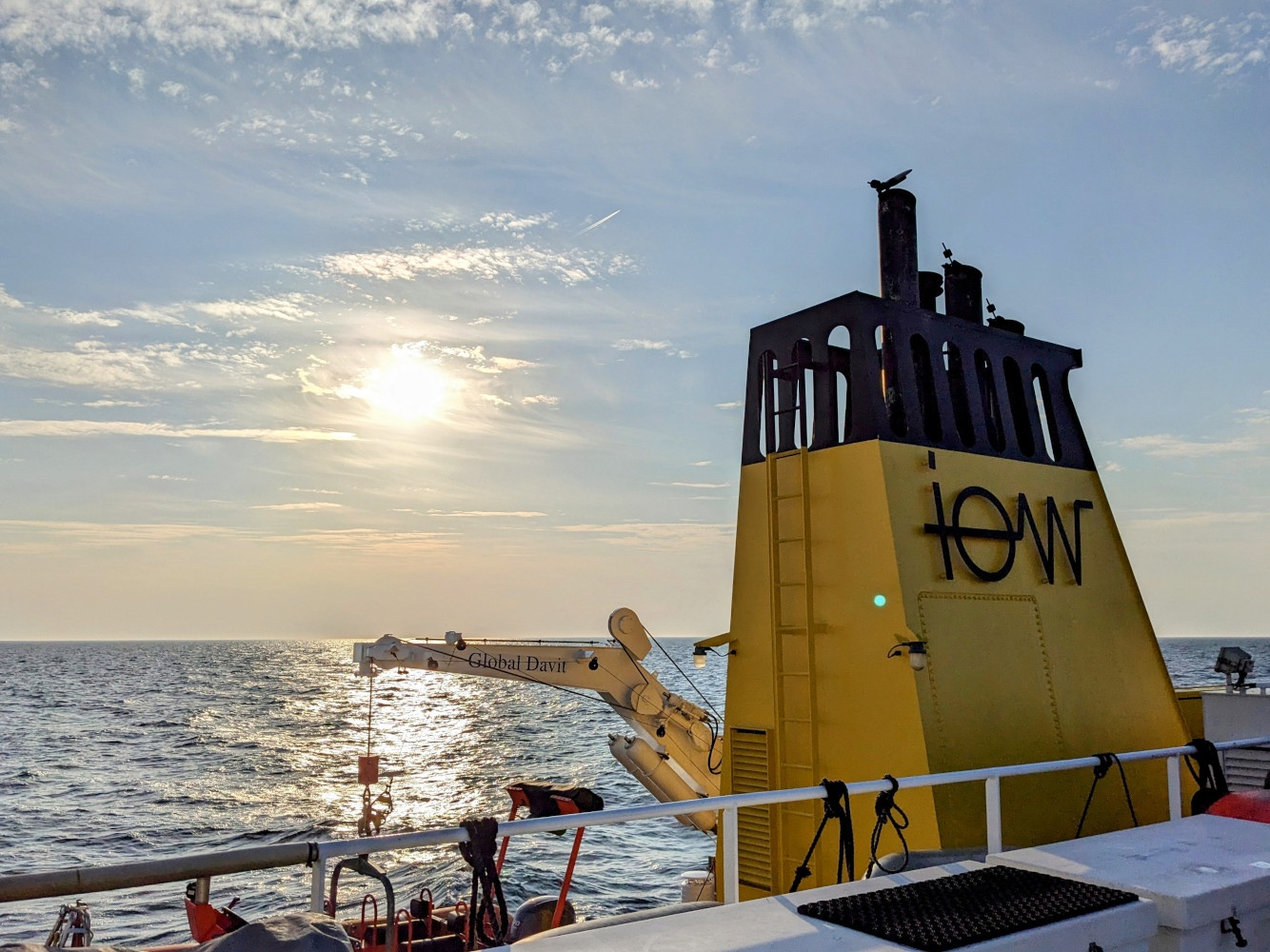
From 17 to 28 April 2023, I joined the cruise EMB316 on research vessel Elisabeth Mann Borgese to the central Baltic Sea. Find some photos and information on the cruise in the blog entry at the SWOT-AdAC website.
My projects at IOW
GROCE: Greenland ice sheet–ocean interaction
| Acronym: | GROCE II |
|---|---|
| Title: | Greenland Ice Shield / Ocean Interaction - From process understanding to the assessment of a coupled regional system under change; Subproject 9: Process-based quantification of subglacial melt rates |
| Website: | https://groce.de/ |
| Duration: | 01.07.2020 - 31.08.2023 |
| Funding: | BMBF - Bundesministerium für Bildung und Forschung |
| Cooperation: | Alfred-Wegener-Institut, Helmholtz-Zentrum für Polar- und Meeresforschung (AWI) University of Bremen Technische Universität Dresden Universität Bonn Friedrich-Alexander-Universität Erlangen-Nürnberg |
| Abstract: |
The motivation of this joint project is to obtain more accurate predictions of climate and sea level changes, in order to provide political decision-makers and the society as a whole with the best possible expert knowledge as a basis for their actions. The second project phase builds on the knowledge, results and collaborations that were developed and established during the first phase of GROCE. The overall goals are to improve our understanding of the dynamics of the changing Greenland system, and to quantify the current and future ice mass loss with greater reliability and accuracy. To achieve these goals, GROCE-2 bundles the excellent expertise of German research institutions in the fields of oceanography, glaciology, geodesy and atmospheric physics, and combines in-situ observations, remote sensing methods, modeling of ocean and glacier dynamics, as well as processes in the atmosphere and the lithosphere over a large range of time scales (intraseasonal to a century) and space scales (few hundred meters to few thousand kilometers). It is the goal of this subproject 9 to estimate melt rates at the water-ice interface below the 79°N glacier (79NG) by means of idealised and spatially highly resolved model simulations. Since the necessary resolution cannot be achieved in realistic coupled ocean-ice-shield models, physical parameterisations and numerical methods will be developed to be integrated in the coupled model of TP2 (ice-shield-ocean interaction – the future of the 79°N glacier). |
TRR 181: Energy Transfers in Atmosphere and Ocean
| Abstract: | SFB/TRR 181 Energy transfers in atmosphere and ocean |
|---|---|
| Website: | http://www.trr-energytransfers.de/ |
| Duration: | 01.07.2016 - 30.06.2028 |
| Funding: | DFG - Deutsche Forschungsgemeinschaft |
| Cooperation: | Alfred-Wegener-Institut, Helmholtz-Zentrum für Polar- und Meeresforschung (AWI) Universität Hamburg, Institut für Meereskunde Helmholtz-Zentrum Hereon Max-Planck-Institut für Meteorologie e.V. Leibniz-Institut für Atmosphärenphysik (IAP) Marum - Zentrum für Marine Umweltwissenschaften der Universität Bremen Jacobs University Bremen Katholische Universität Eichstätt-Ingolstadt |
| Abstract: | The energy transfers between the three dynamical regimes (small-scale turbulence, internal gravity waves and geostrophically balanced motion) are fundamental to the energy cycle of both the atmosphere and the ocean. Nonetheless, they are poorly understood and quanti fied, and their representation in state-of-the-art Earth system models is unsatisfactory. Since the interactions of the dynamical regimes ultimately link the smallest scales to the largest scales by a variety of complex processes, understanding these interactions is mandatory to construct atmosphere and ocean models and to predict climate. The current lack of understanding is refl ected by energetically inconsistent models with relatively large biases, but also paralleled by inconsistencies of a numerical and mathematical nature. We believe that it is now time to combine recent e fforts to overcome these de ficiencies, to foster new activities to understand the dynamical interactions, and to improve the consistency of ocean and atmosphere models. Through the knowledge gained in the CRC, we hope to reduce the biases and to increase the skill of atmosphere and ocean models, and ultimately to improve climate models and climate predictions. The main aims of this CRC are |
Introduction to Scientific Programming with Python
Course in English/German 2021
In the summer semester of 2021, I gave a 5-day introductory course at IOW on scientific programming with the programming language Python and Jupyter notebooks. It consisted of five 1-hour lectures covering the topics:
- Introduction to Python and basic data types
- Data and program structure
- NumPy and SciPy
- MatPlotLib
- Applications to Oceanography: xarray, gsw, and cartopy
The course material can be downloaded from the following links:
Course in German 2022
During the project week of the summer term 2022, I gave a Python introduction at the Institute of Physics, University of Rostock. The material of this 2.5-hour course in German can be downloaded here: