
Biogeochemical Modeling
Our working group
The working group „Biogeochemical modeling“ does both basic and applied research using our marine biogeochemical model ERGOM. The model was developed initially at IOW by Dr. Thomas Neumann and is now used by a community of several research groups around the Baltic Sea for. Details on the research questions our group addresses can be found below. As our research is truly interdisciplinary, we have an intense collaboration with working groups from other departments at IOW.
Basic research
Benthic-pelagic coupling
Sedimentary biogeochemical processes are critical for both the regeneration and removal of nutrients and have a large effect on the water quality and oxygen dynamics in coastal ecosystems. Benthic-pelagic modeling helps to better constrain the processes driving exchange fluxes between sediment and overlying water and resolve the underlying dynamics in response to changing external forcing, such as agricultural nutrient run-off and climate warming.
Anthropogenic disturbances, such as bottom trawling, are investigated in terms of their impact on sediment structure, carbon storage, and biogeochemical cycling, and how these alterations affect water-column processes. In addition, past environmental conditions are reconstructed, including hypoxic events during the Medieval Climate Anomaly, to better understand the natural variability and long-term sensitivity of marine systems to climatic forcing.
Interdisciplinary cooperation at IOW: Geochemistry and Stable Isotope BioGeochemistry (GEO), Marine Geophysics (GEO), Ecology of Benthic Organisms (BIO)
Coast-to-offshore coupling
Shallow coastal seas are highly dynamic regions where physical processes, bentho–pelagic interactions, and human-induced nutrient inputs strongly influence ecosystem functioning. These coastal areas act as a filter, regulating nutrient transport to offshore basins by retaining, transforming, or permanently removing nutrients through coupled physical and biogeochemical processes. Our work divides the German lagoon systems into multiple interconnected basins to investigate how chains of basins sequentially filter nutrients before they reach the open Baltic Seasea. Estimating nutrient retention and filtering efficiency is essential to identify biogeochemically active “hotspot” basins that effectively retain nutrients, as well as corridors where little filtering occurs. Understanding these patterns helps to target observational efforts and design mitigation strategies focused on areas with the highest potential of filter efficiency. here we uses coupled hydrodynamic–biogeochemical models to study the coastal filter, benthic–pelagic coupling, and nutrient cycling in the shallow German coastal waters, providing insights into basin-scale biogeochemical dynamics.
Interdisciplinary cooperation at IOW: Ecology of Benthic Organisms (BIO), Coastal Sea Geography (GEO)
Applied research
Impacts of eutrophication
Eutrophication, mostly induced by excessive nutrient inputs to the sea, is still a key hazard to marine life, biodiversity and ecosystem services. Fully coupled biogeochemical models, which include both the hydrodynamics and the lower trophic cascade, are a key tool to understand the fate of key nutrients (nitrogen, phosphorus, carbon, oxygen) and how they lead to potentially toxic algal blooms. The models allow us to understand, how the desired Good Ecological State of an healthy sea can be characterised and how mitigation measures (like an improved nutrient management on land) can help to achieve a better water quality in coastal waters as well as in open sea waters. Further, the models allow to gain an improved understanding of the spatio-temporal development of key water quality indicators (like near-bottom oxygen) beyond what is possible to monitor with in-situ observations.
Interdisciplinary cooperation at IOW: Coastal Sea Geography (GEO), Ecology of Benthic Organisms (BIO), Integrated Optical Remote Sensing (OBS)
Ocean alkalinity enhancement
Increasing alkalinity lowers the activity of dissolved CO₂ in seawater, which enhances the flux of CO₂ from the atmosphere into the ocean and can thus contribute to long‑term atmospheric CO₂ reduction. In model simulations, we investigate if and to what extent raising alkalinity via calcite addition near the seafloor of the Baltic Sea could remove atmospheric CO₂ while assessing ecological and chemical risks in this sensitive marginal sea. The work is part of the CDRmare consortium’s broader goal to evaluate whether ocean alkalinity enhancement (OAE) can be a safe, effective, and scalable carbon‑dioxide‑removal option. The Baltic is a semi‑enclosed, heavily used, and well‑monitored coastal sea, making it a pragmatic “testbed” for assessing benefits and risks of marine carbon dioxide removal (CDR) close to shore and to stakeholder communities. The results are intended to inform possible local pilot projects, guide regulation and monitoring concepts, and provide data to extrapolate Baltic Sea insights to other coastal regions and eventually global assessments of OAE as a CDR method.
Interdisciplinary cooperation at IOW: Trace Gas Biogeochemistry (CHE), Ecology of Benthic Organisms (BIO)
Models developed
Our working group actively participates in model development at IOW.
The Ecological ReGional Ocean Model (ERGOM)
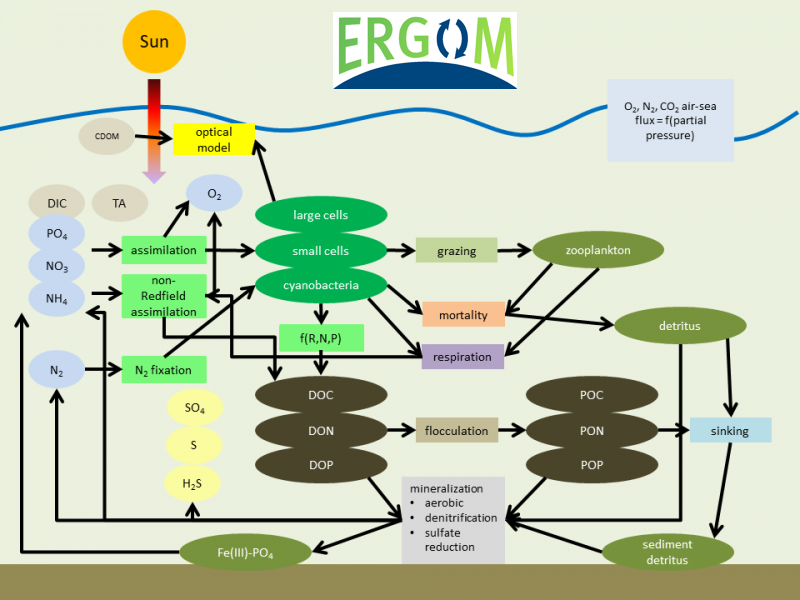
ERGOM is a state-of-the-art ecosystem model developed and maintained by our working group. It simulates element cycles in marine environments, providing valuable insights into biogeochemical processes. Originally designed for the Baltic Sea, ERGOM has since been successfully applied to other coastal regions worldwide. Beyond its use in our own research at IOW, the model is also widely adopted by other research institutes and environmental authorities.
For more detailed information, visit www.ergom.net.
Code Generation Tool (CGT): Simplifying Model Development
To enhance the development and adaptability of ecosystem models, our group created the Code Generation Tool (CGT). CGT features a visual editor and an automated code generator, designed to separate the description of biogeochemical processes from the underlying model code. This approach offers a significant advantage: it allows the biogeochemical model to be easily translated into host-specific code. Additionally, CGT automatically generates code for advanced features such as element tracking, ageing, and vector state variables, streamlining the modeling process.
roboelf offline marine BGC framework
Running marine BGC models is numerically much more expensive than using purely hydrodynamic models. The main reason is that BGC models contain many state variables that all need to be advected with the ocean currents.
To allow for cheaper model runs, our group is developing an offline framework, that is, the BGC simulations are run independently from the hydrodynamic model, using its output (e.g., the simulated currents).
The „roboelf“ framework we are developing posesses several properties which make it uniquely efficient:
- Faster and cheaper by running on GPUs rather than CPUs
- Lagrangian advection scheme allows larger time steps
- Efficient parallelization of multi-model ensembles in a single run (e.g. running sensitivity analyses)
For the future, our plan is to use the computational efficiency benefits for enabling objective model calibration and uncertainty estimation.
Members
Dr. Thomas NeumannWorking group leader (Co-lead),
Biogeochemical model development
Dr. Hagen Radtke
Working group leader (Co-lead),
Biogeochemical model development
Dr. Anju Mallissery
Deputy working group leader,
Biogeochemistry of coastal ecosystems
Dr. Anna-Adriana Anschuetz
Marine CDR Methods
Dr. René Friedland
Applied ecosystem modelling,
Assessment of marine ecosystem status
Dr. Jurjen Rooze
Marine sediment geochemistry,
Impact of fisheries