

Optical nitrate measurement
The project optical nitrate measurement is concerned with optimisation of the parameters for fitting absorption spectra measured in sea water to calibration spectra. While these optimisations should be of a general nature, for the measurements we use an OPUS instrument from the company TriOS.
Principle of optical nitrate determination
The absorption of nitrate, dissolved in water, in the ultraviolet (UV) region of the electromagnetic spectrum has long been known. For the determination of nitrate concentration in seawater using the absorption spectrum the contribution of the nitrate to the total absorption has to be identified. Since other constituents of seawater also absorp in the UV region of the spectrum (e.g. the salts, H2S, humic acid) the identification of the nitrate contribution to the absorption spectrum is not straight forward.
The absorption is measured at a range of wavelengths, then the resulting absorption spectrum is fitted to a linear combination of calibration spectra using a mathematical algorithm. The calibration spectra have been recorded previously in the laboratory by dissolving the individual contributors (e.g. salt, H2S, humic acid) in pure water and then taking absorption spectra of this solution.
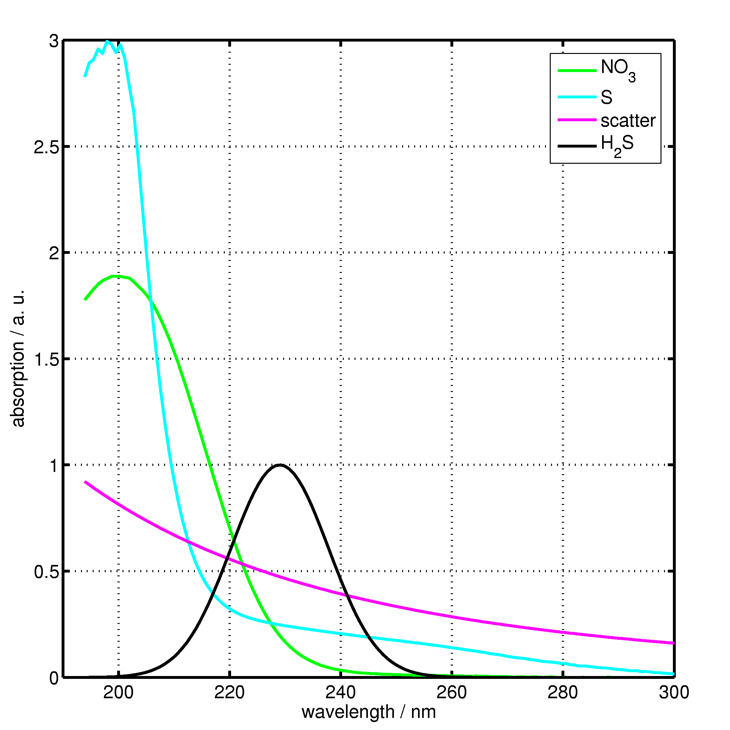
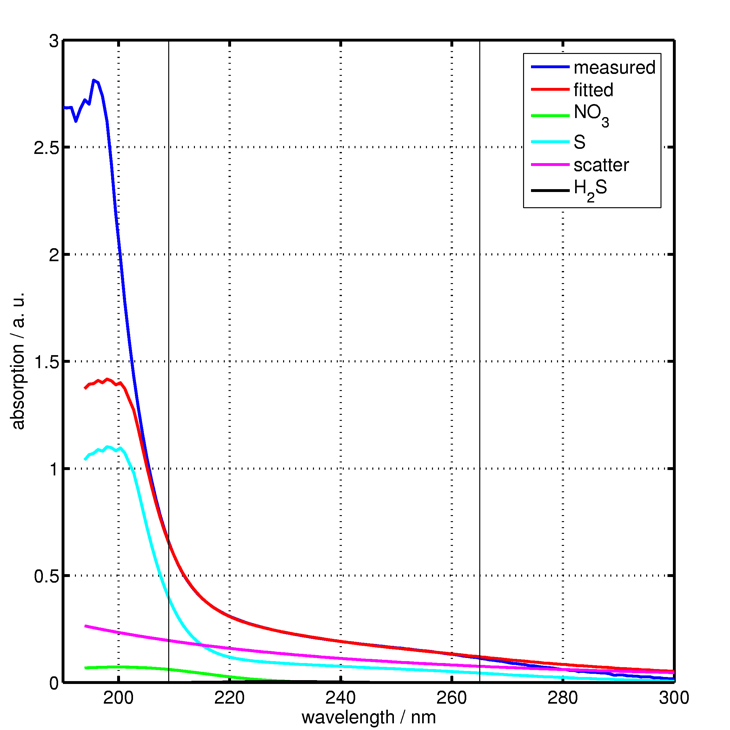
The algorithm used for fitting the absorption spectra of the seawater samples to the calibration spectra, called multiple linear regression, has a number of parameters (e.g. range of wavelengths to fit, calibration spectra to include, admission of negative concentrations) that have to be optimised for the waters of the deployment region (in our case the Baltic Sea). To find the optimisation we are working together with the nutrient group within the Bio-physical interactions workgroup, who are analysing the samples with standard wet chemical methods in the laboratory and are our 'gold standard'.


The left image above shows a qualitative image of the hydrogen sulfite concentrations in the Gotland Basin when the inflow water from the major Baltic inflow of 2014/2015 reached the mooring position of the GODESS in March 2015. The right image shows the concentration of dissolved oxygen at the same time interval.
The accuracy of the concentration values is not as good as the wet chemical laboratory methods, especially in coastal waters with many different absorbing materials. The main advantage of the optical method, however, is that measurements can be carried out rapidly and in situ. No reagent consumption also means that long term measurements are much easier to realize than with wet chemical in situ analysers.